

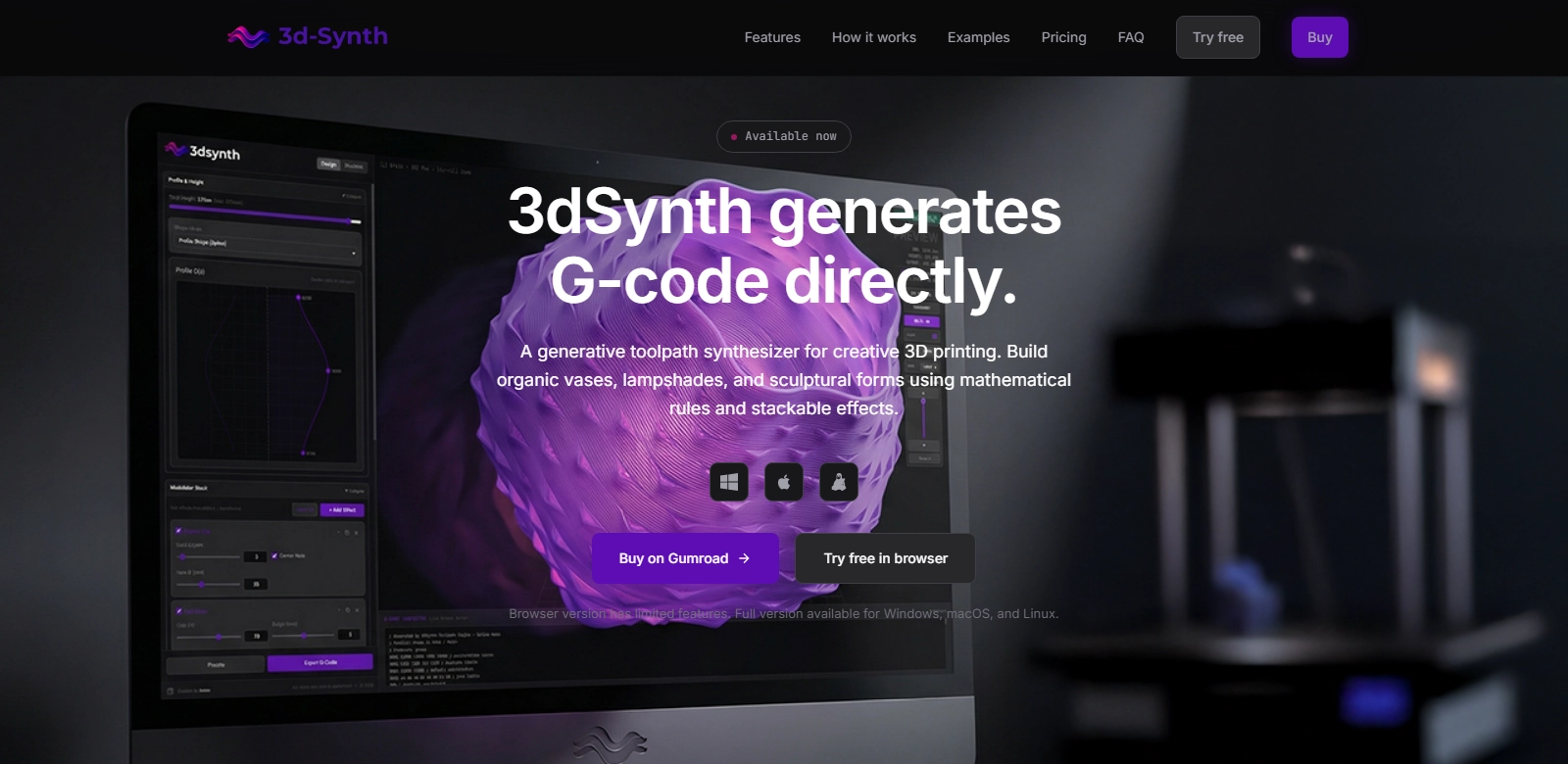
3dSynth: Revolutionizing 3D Printing with Generative G-code
In the landscape of modern 3D printing, 3dSynth stands out as a groundbreaking platform that generates G-code directly from mathematical rules, eliminating the need for STL files and slicers. This revolutionary approach allows creators to design organic shapes, intricate vases, lampshades, and sculptural prints with unprecedented ease and creativity. By leveraging the power of mathematical algorithms, 3dSynth empowers users to explore the limitless possibilities of 3D printing without the constraints of traditional methods. 3dSynth thus becomes a crucial tool for both hobbyists and professionals who seek to push the boundaries of their creations.
Customers of 3dSynth
Understanding the diverse customer base that benefits from 3dSynth is essential for grasping its impact. The platform caters to a wide array of users, each requiring unique features to meet their printing needs. Here is a detailed analysis of its customer personas:
-
Hobbyist Makers:
For hobbyists, 3dSynth provides an accessible gateway into the world of 3D printing. These users often lack the technical expertise for conventional CAD software and slicing programs. 3dSynth enables them to create visually stunning and complex designs through simple mathematical inputs, allowing their creative visions to come to life without a steep learning curve. -
Product Designers:
Product designers can leverage 3dSynth to iterate on their designs rapidly. The generative G-code approach allows them to test various iterations of their concepts quickly, saving both time and resources. This agility in the design process leads to more innovative products while ensuring that designers can maintain design intent with intricate geometries that appeal to modern consumers. -
Artists and Sculptors:
For individual artists and professional sculptors, 3dSynth brings a new medium for expression. The capability to create complex, organic forms enables artists to explore design elements that were previously difficult to translate into 3D print formats. The resulting pieces can evolve continuously, showcasing fluidity and motion captured in static forms, appealing to art collectors and galleries. -
Educators:
Educators in design and engineering fields can utilize 3dSynth as a teaching tool. With its straightforward interface for generating G-code, students can focus on creative ideas and problem-solving instead of getting bogged down by intricate software. This fosters a more profound understanding of 3D printing principles and design thinking. -
Small Businesses:
Small businesses looking to create unique products or prototypes can immensely benefit from 3dSynth's capabilities. The ability to design and manufacture customized items without relying on third-party slicer programs reduces overheads and opens up new revenue streams for entrepreneurs.
Problems and Solution by 3dSynth
In the realm of 3D printing, several challenges hinder creativity and efficiency. 3dSynth addresses these issues head-on.
Problems 3dSynth Found
-
Complex Software Dependency:
Many users find themselves constrained by the steep learning curves associated with traditional CAD and slicing software. This reliance can discourage creativity and limit the functionality of printing designs. -
File Format Limitations:
STL files, the predominant format in 3D printing, can often fail to represent complex geometries accurately, resulting in compromised designs that do not meet original creative intentions. -
Time-Consuming Iteration Processes:
For designers and hobbyists alike, refining designs can be a tedious process requiring multiple software applications, leading to wasted time and materials. -
Lack of Customization Options:
Many existing platforms lack the flexibility for users to generate highly customized designs, particularly for organic shapes that reflect natural forms and patterns.
Solution by 3dSynth
3dSynth revolutionizes the approach to 3D printing by integrating algorithmic design and G-code generation into a single, fluid process. This unique system not only eliminates the need for STL files but also minimizes the necessity for traditional slicer programs. By allowing users to input mathematical rules, 3dSynth generates G-code that is directly used for printing, thus streamlining the workflow. Customers can fabricate complex objects in a matter of clicks, thereby enhancing productivity while preserving their intricate designs.
The tool opens up new creatives avenues for artists and designers, allowing them to explore forms previously deemed too complex or difficult to achieve with conventional methods. Additionally, its user-friendly interface caters to various skill levels, making 3D printing more accessible and enjoyable for everyone.
Use Case
A variety of use cases illustrate the tremendous potential of 3dSynth in different fields:
-
Architectural Modeling:
Architects can use 3dSynth to create detailed models highlighting organic structures, helping visualize their designs more effectively and facilitating client presentations. -
Jewelry Design:
Jewelry makers can generate intricate patterns that incorporate organic shapes in their pieces, distinguishing their products in a crowded market. -
Industrial Prototyping:
Industries focused on rapid prototyping can create test models with complex geometries, ensuring optimal form and fit before the final production phase, thus saving costs. -
Educational Projects:
Schools and colleges can utilize 3dSynth in STEM-related projects, helping students understand mathematical concepts through physical model-making while keeping them engaged.
Top Features of 3dSynth
Exploring the capabilities of 3dSynth reveals a wealth of features that cater to a diverse user base:
-
Mathematical Rule-Based G-code Generation:
This innovative feature allows direct conversion of mathematical expressions into print-ready G-code, offering a unique way to design 3D models. -
Organic Design Capabilities:
Users can effortlessly create flowing designs that mimic nature, providing an entirely new creative outlet for artists and designers. -
User-Friendly Interface:
The platform is designed to ensure that users with diverse backgrounds can navigate and create models without a steep learning curve, making it broadly accessible. -
Rapid Prototyping Features:
The quick generation of designs enables users to test and iterate their concepts with remarkable speed, enhancing productivity. -
Educational Resources:
3dSynth provides resources for educators, helping to bridge the gap between theoretical concepts and practical applications within the realm of 3D printing.
Frequently Asked Questions with 3dSynth
-
How does 3dSynth differ from traditional slicing software?
3dSynth operates by directly producing G-code from mathematical rules, bypassing the need for STL files and conventional slicing processes. This not only simplifies the workflow but also opens up vast creative possibilities that traditional methods cannot offer. -
Can I use 3dSynth for complex designs?
Yes, one of 3dSynth's key advantages is its ability to create complex organic designs with ease, allowing users to transcend the limitations of typical CAD software. The mathematical model approach enables the generation of intricate geometries that reflect natural forms. -
Is 3dSynth suitable for beginners?
Absolutely. With its user-friendly interface and straightforward functionality, beginners can quickly start creating 3D models without needing extensive prior knowledge or experience in software tools. -
What types of materials can be used with prints generated from 3dSynth?
The G-code produced by 3dSynth is compatible with a wide range of 3D printers and materials, allowing for flexibility in the types of products you can create, from plastics to metals. -
Are there resources available for learning more about using 3dSynth?
Yes, 3dSynth provides various educational resources, including tutorials and documentation, to help users maximize their experiences and learn effective design strategies.