
Understanding AI Dependency: A Comprehensive Assessment
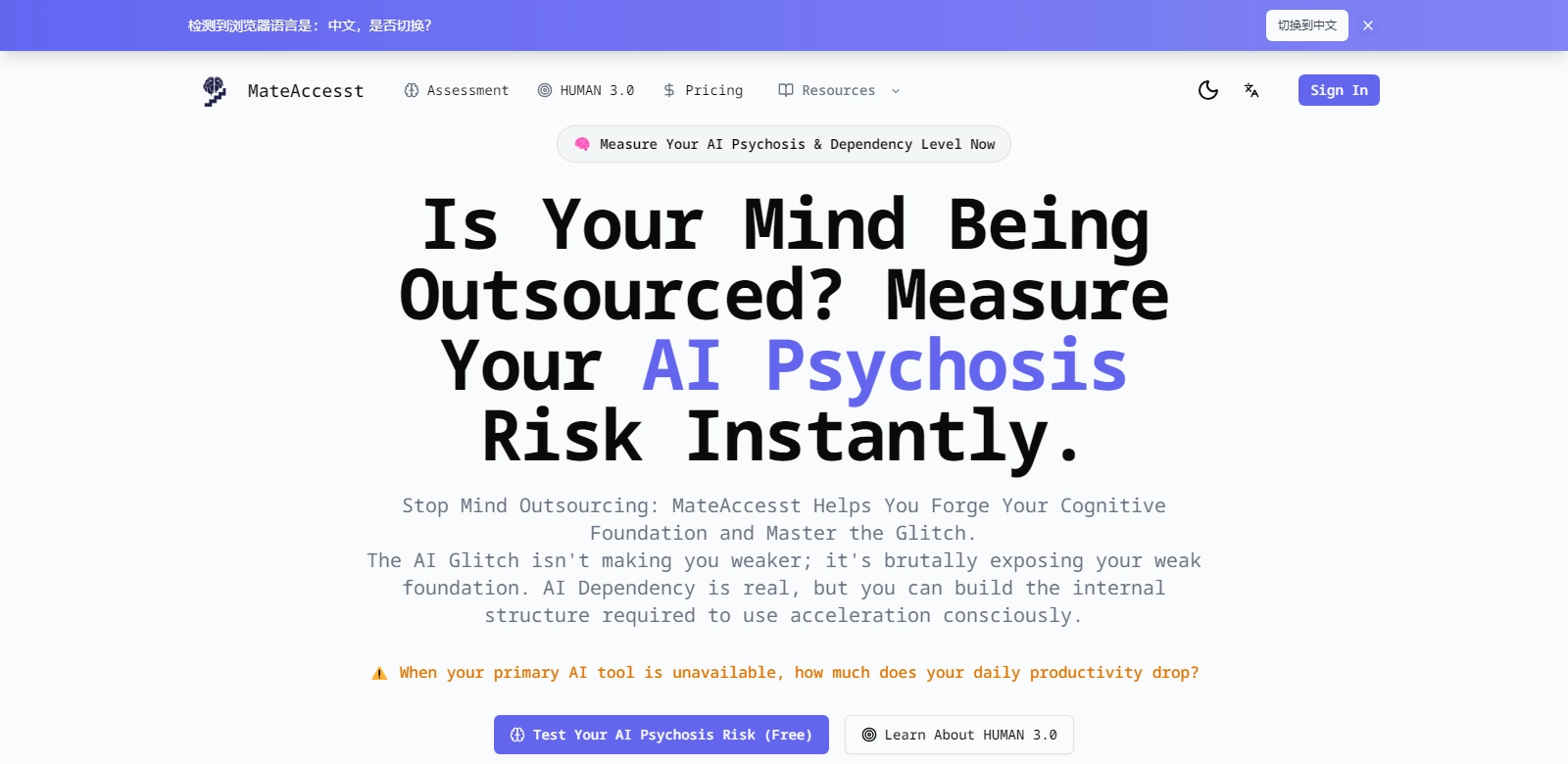
In today's technology-driven world, artificial intelligence (AI) is increasingly woven into the fabric of everyday life. While AI tools can enhance productivity and decision-making, there's a critical need to assess the extent of dependency on these systems. The AI Psychosis Risk Test from MateAccess offers an essential service by measuring an individual's AI Dependency Score through the HUMAN 3.0 Assessor. This assessment aims to find the root cause of self-improvement fragmentation and unlock individualized protocols for healthier tech interactions.
Customers of MateAccess
The AI Psychosis Risk Test is designed for a diverse range of users, each with unique needs. Understanding these customer personas is crucial for tailoring the service effectively.
-
Tech Professionals:
As tech professionals increasingly rely on AI tools for daily tasks, understanding their dependency is vital for maintaining productivity without losing critical thinking abilities. This demographic can benefit significantly from the insights offered by the AI Dependency Score. -
Mental Health Practitioners:
Therapists and psychologists can leverage the test’s outcomes to guide clients who struggle with technology-related anxiety. By understanding the triggers of tech dependency, mental health professionals can provide focused interventions and support. -
Educators:
In the education sector, teachers who integrate AI in their teaching processes can assess whether their reliance on technology hinders students' critical thinking skills. The assessment can help in creating a balanced tech use policy in classrooms. -
Parents:
With a rising concern about screen time and digital learning for children, parents utilizing this risk test can better gauge their children's dependency on AI technologies and find ways to encourage healthier habits. -
Corporate Leaders:
Understanding AI dependency helps leaders in companies foster a workplace culture that balances technology use with human insights. This assessment can thus facilitate a healthy work environment.
Problems and Solutions by MateAccess
Every innovative solution tries to address specific problems in society. The AI Psychosis Risk Test identifies the following:
Problems MateAccess Found
-
Over-Reliance on Technology:
Many users find themselves excessively dependent on technology, leading to decreased cognitive engagement and critical thinking. This problem can impede individual growth, making it challenging to tackle tasks that require human intuition and judgment. -
Mind Outsourcing:
Individuals often simplify complex decisions by relying excessively on AI tools, a phenomenon called mind outsourcing. This leads to fragmented self-improvement and a lack of personal agency. -
Fragmentation of Self-Improvement:
Accessing numerous AI tools can create a disjointed approach to self-improvement, making it difficult to focus on personal goals. This overwhelm can hinder progress.
Solution by MateAccess
MateAccess offers a systematic approach to measure AI dependency using the HUMAN 3.0 Assessor. By interpreting the score, users can identify their level of dependence on technology and understand the underlying issues causing their dependency. Through personalized feedback, the service presents a tailored 30-Day Decoupling Protocol aimed at gradually decreasing over-reliance on AI assistance while fostering personal growth and self-improvement.
Use Case
For example, a corporate leader could utilize the AI Dependency Test to assess not only their own scores but also that of their teams. By analyzing the results, they could implement workshops aimed at reducing dependency on AI tools while enhancing employees' critical thinking skills. This strategy may simultaneously boost collaboration and innovation in the workplace.
Top Features of MateAccess
The AI Psychosis Risk Test presents several standout features:
-
HUMAN 3.0 Assessor:
This advanced tool evaluates AI dependency through various parameters, providing users with a comprehensive score that highlights their reliance on technology. -
Personalized Decoupling Protocol:
Based on assessment outcomes, users receive tailored guidance to help mitigate dependency and enhance self-improvement. -
In-Depth Analysis:
Users get a detailed understanding of their results, enabling insightful discussions with professionals about personal growth strategies. -
User-Friendly Interface:
The test is designed to be accessible for all users, regardless of technical skill, making it simple to navigate and understand. -
Proactive Recommendations:
Following the assessment, participants receive actionable steps and resources to improve their AI interaction.
Frequently Asked Questions with MateAccess
-
How does the AI Dependency Score work?
The AI Dependency Score provides a quantitative measure of how much someone relies on AI for decision-making and daily tasks, helping individuals identify their dependency levels. -
What is a Decoupling Protocol?
The Decoupling Protocol is a personalized 30-day plan aimed at reducing reliance on AI tools while promoting personal growth through independent thinking and decision-making. -
Can this assessment help in professional settings?
Yes, the AI Dependency Test can help corporate environments to understand team dynamics, promoting a balanced use of technology and enhancing overall productivity. -
Is the assessment suitable for all ages?
Absolutely! The test caters to users from different demographics, including children and adults. -
What resources are provided post-assessment?
Users receive personalized recommendations and access to workshops that promote healthier interactions with AI technologies.